SHELTER NECK UU CAMP
Shelter Neck School, also known as the Carolina Industrial School at Shelter Neck, includes a 39-acre parcel, of which nine acres around a group of buildings is cleared. The complex includes a chapel, the school building itself, a house, an outbuilding, and a gazebo.
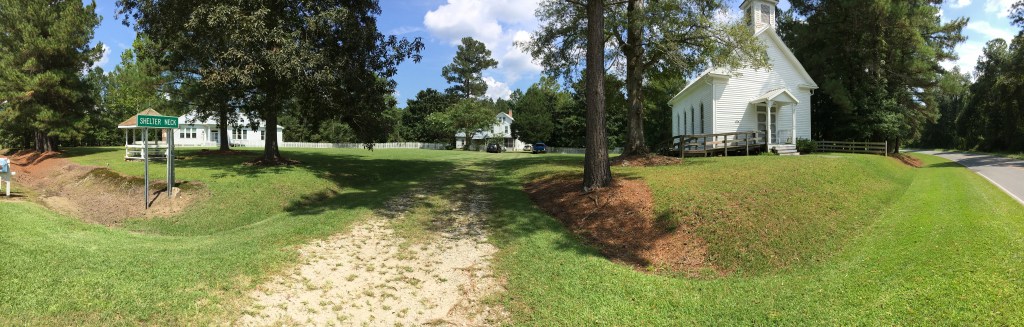
History of the Site
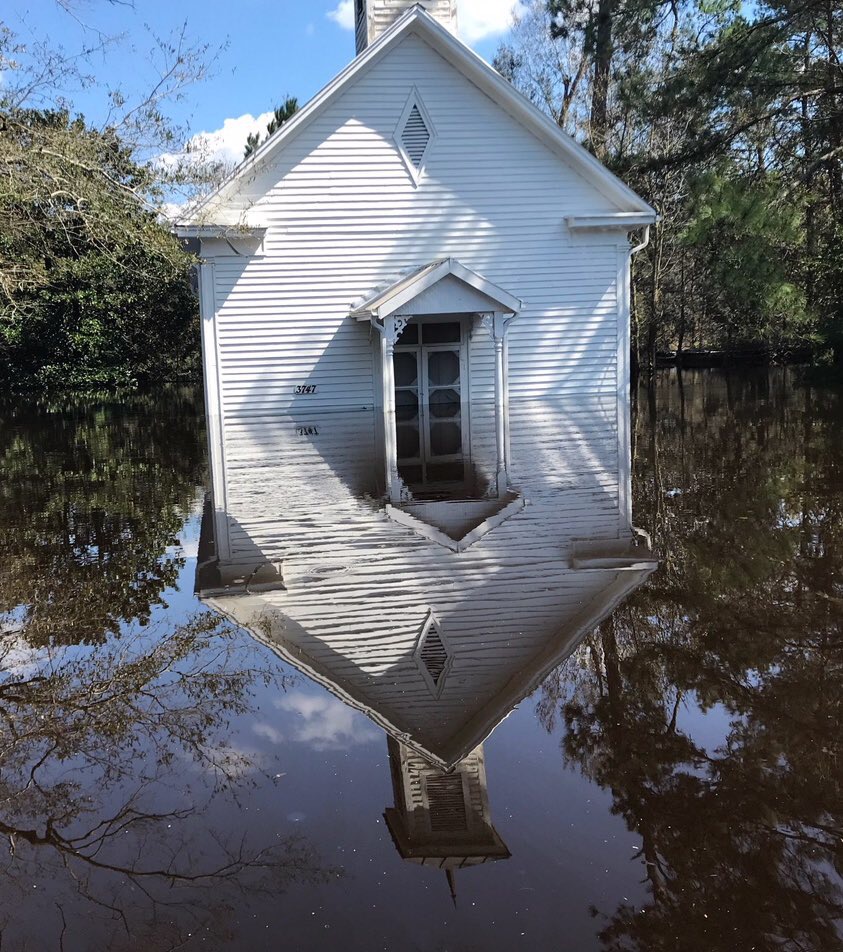
Shelter Neck, the location of the settlement school established by Boston Unitarians starting in 1900, acquired its name for its position on the “neck,” or dry land between the Northeast Cape Fear River and Holly Shelter Creek. The settlement school’s location, which is nearly surrounded by swamps, rivers, and streams, has made it particularly susceptible to flooding for almost its entire history. The first significant inundation came in 1908. More recently, storms in 1999 and 2018 have sent water rushing onto the property. Hurricane Florence in September 2018 produced catastrophic flooding at the site.
Settlement schools like the one established at Shelter Neck in 1900 were part of a social reform program inspired by the settlement movement that began in London in the late nineteenth century and spread to the United States in the early twentieth century with the founding of Hull House in Chicago. For the Alliance of Unitarian Women, the goal at Shelter Neck was to establish a school and church that would teach “the message of Jesus in all its simplicity and purity.”
For over twenty-five years, the Unitarian settlement school on the banks of the Northeast Cape Fear River enjoyed a stellar reputation for the education it offered local white children. Financial strains, changes in leadership among the Unitarians operating the school, and improvements in local public education and transportation led the Alliance of Unitarian Women to close the school in 1926. For a period, the Pender County Board of Education rented the school building for use as a public school.
In January 1932, the General Alliance of Unitarian and Other Liberal Christian Women, the successor name for the original organization, sold the four tracts making up the school property to the Universalist Convention of North Carolina. Since the 1930s, the Universalist Convention (UCONCI) has used the property as a camp, retreat center, and meeting place.
Donate:
Donations to the Shelter Neck Recovery Fund will be used to renovate and raise flooded buildings.
Click Donate Button below to give via PayPal, debit card, or credit card
Donate
Or make checks payable to
“Universalist Convention of North Carolina, Inc.”
and put “Shelter Neck Recovery Fund” in the memo field.
Please mail checks to:
Universalist Convention of North Carolina, Inc.
1670 NC Highway 33 West, Chocowinity, NC 27817
Historic Site location:
3747 Croomsbridge Road
Burgaw, NC 28425
https://maps.app.goo.gl/rTRFCejXJbuji1w68
While we rehabilitate from the flooding, you can visit us at:
From Raleigh and points west of Pender County/Burgaw:
Follow I-40 East to Exit # 390 onto Hwy. 117 South toward Burgaw;
Go about 6 miles (look for and follow Well’s Pork signs),
Turn left onto Croomsbridge Road – just past Sweet Bee’s Grill.
Go about 3 miles, past Mino’s Meat Market, and over the NE Cape Fear River Bridge.
Go another 3/4 mile to Shelter Neck in curve on left. The driveway is between the green Shelter Neck sign and the chapel.
From Wilmington and points east of Pender County/Burgaw:
Follow I-40 West to Exit # 398, Exit onto Hwy. 53 NE toward Jacksonville.
Go about 5 miles to left turn onto Croomsbridge Rd. Go about 3 miles.
Look for a curve in the road with the chapel on the right as well as the three-story house, schoolhouse, and gazebo.
The driveway is between the green Shelter Neck sign and the chapel.
From Morehead City and Beaufort (approximately 71 miles from Morehead to Shelter Neck)
Follow Hwy 24 about 43 miles though Jacksonville; join Hwy 258 for short distance and exit onto Hwy 53 toward Burgaw.
Follow Hwy 53 approximately 22-25 miles watching for Holland’s Shelter Creek Campground on left.
About one half mile after Holland’s, turn right onto Croomsbridge Road and continue for about 3 miles.
Look for a curve in the road with the chapel on the right as well as the three-story house, schoolhouse, and gazebo.
The driveway is between the green Shelter Neck sign and the chapel.
From New Bern (approximately 64 miles to Shelter Neck)
Follow Hwy 17 approximately 36 miles to Jacksonville.
Take Hwy 258 a short distance and exit onto Hwy 53 toward Burgaw.
Follow Hwy 53 approximately 22-25 miles watching for Holland’s Shelter Creek Campground on left.
About one half mile after Holland’s, turn right onto Croomsbridge Road and continue for about 3 miles.
Look for a curve in the road with chapel on the right as well as the three-story house, schoolhouse, and gazebo.
The driveway is between the green Shelter Neck sign and the chapel.
From Greenville (approximately 91 miles to Shelter Neck)
Take Hwy 11 south through Kinston and Kenansville to I-40.
Take I-40 east to Exit # 390 onto Hwy. 117 South toward Burgaw;
Go about 6 miles (look for and follow Mino’s signs).
Turn left onto Croomsbridge Road – just past Sweet Bee’s Grill.
Go about 3 miles, past Mino’s Meat Market, and over the NE Cape Fear River Bridge.
Go another 3/4 mile to Shelter Neck in curve on left.
The driveway is between the green Shelter Neck sign and the chapel.
Shelter Neck Leadership
UCONCI Officers:
President – Debbie Robertson
Vice Pres. – Billy Liles
Secretary – Marion Hirsch
Treasurer – Feryl Masters
UCONCI Trustees:
Trustee – Delthea Simmons
Trustee – Thomas Clayton
Trustee – Ethan Gilbreath
Trustee – Allison Andrade
Trustee – Vacant
Trustee – Vacant
UCONCI – Member Congregations
| Chapel Hill, NC | Community Church of Chapel Hill, UU officemgr@c3huu.org 106 Purefoy Rd. Chapel Hill NC 27514-4853 |
| Clinton, NC | First Universalist Church of Sampson County at Red Hill billypeterson@earthlink.net 7031 Taylor’s Bridge Hwy. Clinton, North Carolina 28328 |
| Durham, NC | Eno River UU Fellowship office@eruuf.org 4907 Garrett Rd. Durham NC 27707-3443 |
| Greenville, NC | UU Congregation of Greenville office@uugreenvillenc.org 131 Oakmont Dr. Greenville NC 27858-5937 |
| Kinston, NC | UU Congregation of Kinston GroveParkUU@gmail.com meets at: Temple Israel, 1109 W Vernon Aveservices on 2nd & 4th Sundays at 4 pm mailing address: P. O. Box 1397, Kinston, NC 28503 |
| Kitty Hawk, NC | Unitarian Universalist Congregation of the Outer Banks 843 Herbert Perry Road, Kitty Hawk, NC mailing address: P.O. Box 1006, Kitty Hawk, NC 27949 |
| Morehead City, NC | Unitarian Coastal Fellowship tarwathie@clis.com 1300 Evans St. Morehead City NC 28557-4141 |
| New Bern, NC | Unitarian Universalist Fellowship of New Bern uufnb@yahoo.com Services at 10:30 Every Sunday 308 Meadows Street, New Bern, NC |
| Raleigh, NC | UU Fellowship of Raleigh office@uufr.org 3313 Wade Ave. Raleigh NC 27607-4123 |
| Raleigh, NC | UU Peace Fellowship General Inquiries – uupfellowship@yahoo.com 4104 Watkins Rd, Raleigh, NC |
| Seven Springs, NC | Outlaw’s Bridge UC 4408 NC Hwy 111 N. Seven Springs NC 28578-7517 |
| Whispering Pines, NC | UUCongregation of the Sandhills uucsandhills@gmail.com Whispering Pines Community Center 1320 Rays Bridge Rd, Whispering Pines, NC 28327 |
| Wilmington, NC | UU Congregation of Wilmington office@uucwnc.org 4313 Lake Ave. Wilmington NC 28403-5513 |
 Shelter Neck